

How to Optimize Your Storage Facility’s Google Business Profile
Your Google Business Profile carries roughly a third of the weight in local search rankings. It costs nothing. And at most independent storage facilities it was set up once, years ago, and never touched again.
That combination is the largest single opportunity in self-storage marketing. We’re going to go through the most critical parts of setting this up.
Why the profile outweighs your website
For a local search like “storage units near me,” Google shows the map pack, three business listings with a map, above the organic results. Most clicks go there.
The map pack is driven primarily by your Google Business Profile. Your website matters, but it matters as a supporting signal to the profile rather than the other way around.
Whitespark’s 2026 Local Search Ranking Factors survey puts profile signals at roughly 32 percent of map pack weight, ahead of reviews at 20 percent, on-page signals at 15 percent and links at 8 percent (Whitespark, 2026 Local Search Ranking Factors).
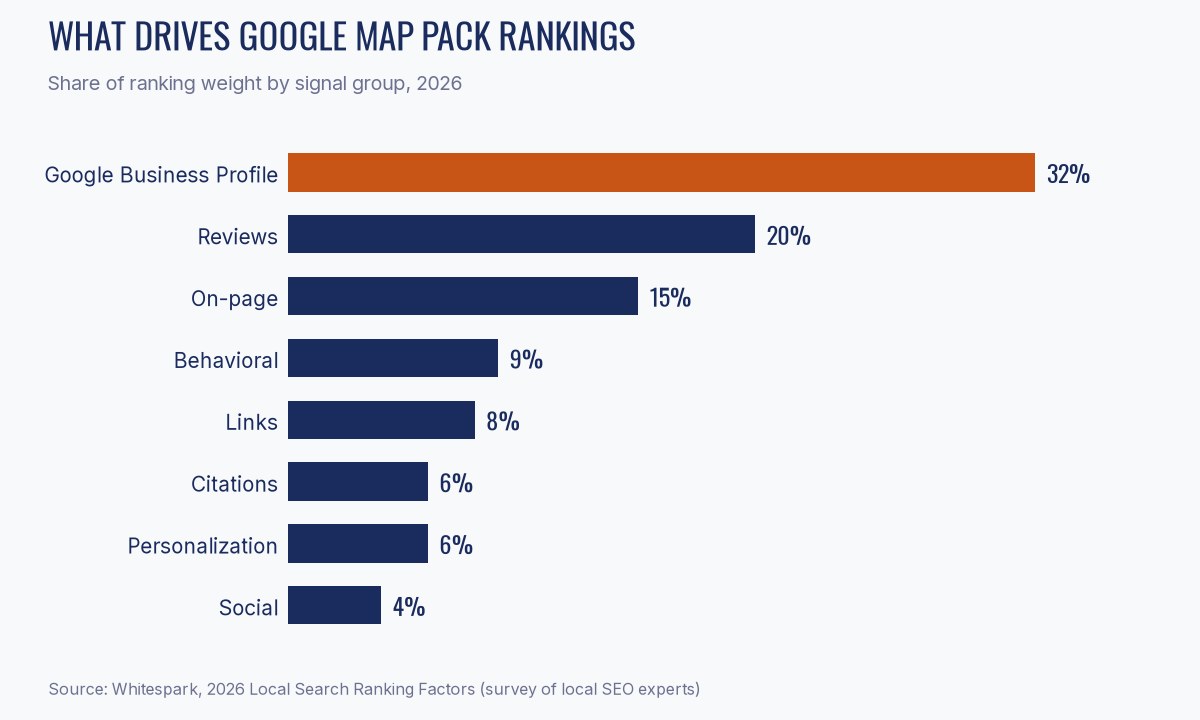
For a business where nearly every customer search is local, that makes the profile the most valuable free asset you own. For how it fits with your website, reviews and listings, see the complete self-storage SEO guide.
Categories: get this right first

The primary category is the strongest relevance signal in the entire profile, and it is a single dropdown.
Set your primary category to “Self-storage facility.” Not “storage facility,” not “warehouse,” not “moving company.”
Secondary categories should be added only where genuinely accurate. Useful ones for storage:
- Moving and storage service, if you actually offer moving help or truck rental
- RV storage facility, if you have RV spaces
- Boat storage facility, if applicable
- Records storage facility, if you serve business clients
- Automobile storage facility, if applicable
Do not add categories aspirationally. Irrelevant categories dilute relevance rather than expanding reach, and they can pull you into searches you cannot serve. You want to only show up for consumers you can actually service.
Complete every single field

Completeness is a ranking factor and a conversion factor, and it is the cheapest work available.
Business name. Your real name exactly as it appears on signage. Do not stuff keywords. “Ocala Self Storage” is fine if that is the name. “Ocala Self Storage Cheap Climate Controlled Units Near Me” risks suspension.
Address. Exactly as it appears on your website and directory listings. Down to whether you write “Ave” or “Avenue.”
Phone. A local number where possible. It should match your website.
Website. Link to the facility page for that location, not the homepage, if you run multiple facilities. Here is how to build a facility page that ranks.
Hours. Office hours and gate access hours are different things and this confuses customers constantly. Put office hours in the hours field, then use the description and a post to make access hours explicit. Set holiday hours in advance.
Opening date. Add it. Longevity is a small prominence signal.
Description. 750 characters. Write for a customer, not a search engine. Cover what you offer, the area you serve, and what makes the facility worth choosing. Mention unit types and neighborhoods naturally.
Attributes. Work through every one Google offers and set it accurately. Online rentals, on-site staff, security, accessibility, payment options, women-owned or veteran-owned if applicable. Attributes appear in the listing and some are filterable.
Products: the most underused feature in storage

This is the biggest missed opportunity in the entire profile, and it exists for storage almost perfectly.
Add every unit size as a Product. Each one gets a name, a photo, a price and a description.
Name:        10x10 Storage Unit
Price:       From $145/month
Description: About half a garage. Fits a one to two bedroom
             apartment including appliances. Drive-up access,
             ground floor. Available now at our Ocala facility.
Why this matters so much:
- It fills your profile with the exact phrases people search, including sizes
- Products display visually in the listing, taking up more space
- It answers the two questions every storage customer has, size and price, before they click anything
- Almost no competitor is doing it, including the REITs
Do all your sizes. Ten products beats three.
Photos

Photos affect engagement, and engagement signals feed prominence. They also affect whether someone chooses you, because people renting storage want to see whether the place looks secure and clean.
What to upload:
- The gate and entrance, including how it looks from the road so people recognize it while driving
- The office and, if you are comfortable, the manager
- Hallways and corridors, showing lighting and cleanliness
- A unit interior with the door open, ideally with something for scale
- Different unit sizes, matching your Products
- The truck turnaround and drive-up access
- Security features: cameras, keypad, fencing, lighting
- Exterior signage
Practical rules. Use real photos, never stock. Shoot in daylight. Upload a few new ones monthly rather than fifty at once. Geotagging does nothing, so ignore anyone selling it.
Posts

Posts appear in your listing and signal an active business. Weekly is a reasonable target.
What to post about:
- Move-in specials and current promotions
- Seasonal reminders, tied to moving season, holidays, RV season, student move-out
- Facility updates: new gate, resurfaced lot, added cameras, extended hours
- Unit availability, particularly when a popular size opens up
- Storage tips relevant to your climate
- Community involvement
What not to post: anything generic enough that it could be about any business anywhere.
Questions and answers

The Q&A section is public, anyone can answer, and on most storage profiles it sits empty or contains a wrong answer from a stranger.
You can and should ask and answer your own questions. This is explicitly allowed.
Seed ten questions covering what your manager actually gets asked:
- What do I need to rent a unit?
- Do you require a deposit?
- What are your gate access hours?
- Do you have climate controlled units?
- Can I get a moving truck into the property?
- Do you prorate the first or last month?
- Is a lock included?
- Do you require insurance?
- What sizes do you have available?
- Do you offer month-to-month rental?
Answer each fully and factually. Every answer is also content that can be surfaced in AI search results.
Reviews

Review signals carry around 20 percent of map pack ranking weight and close to all of the trust decision.
Ask at move-in. In person, at the counter, while the customer is happy. A printed card with a QR code outperforms email substantially.
Velocity beats volume. A steady flow of recent reviews signals an active business more strongly than a large stale pile.
Respond to every review, positive and negative, within a few days.
Never buy reviews. The downside is losing the asset that carries a third of your visibility.
Messaging and calls
Messaging. Enable it only if someone will actually respond quickly. A slow response is worse than none.
Call history. Turn it on so you can see how many calls the profile generates. Most operators discover they are missing more calls than they thought, and that is frequently the highest-return fix available anywhere in their marketing.
Reading the performance data
The profile’s own performance report is the most useful free reporting in local marketing. Check monthly:
- Searches, split by direct, discovery and branded. Growth in discovery searches means more new people are finding you.
- Calls, direction requests, website clicks, and bookings. These are the closest thing to revenue.
- Search queries. What people actually typed. This is free keyword research from your own market.
Direction requests are the most underrated metric in storage. Someone requesting directions to a storage facility is very close to renting.
What suppresses a profile
Things that quietly hold you back:
- Inconsistent NAP. Different name, address or phone across listings.
- Keyword-stuffed business name. A suspension risk.
- Wrong or missing primary category.
- Duplicate listings. Common where a facility has changed hands or rebranded. Find and merge them.
- A virtual or shared address. Storage is fortunate here, since you have a real building.
- Long-abandoned profiles. No posts, no new photos, unanswered reviews and questions.
A realistic first pass

Set aside one afternoon:
- Confirm the primary category (5 minutes)
- Complete every field, including attributes (30 minutes)
- Write the description (15 minutes)
- Add every unit size as a Product (60 minutes, the most valuable hour)
- Upload ten real photos (45 minutes including shooting)
- Seed ten Q&As (30 minutes)
- Respond to every existing review (varies)
- Set up the review request card at the counter (15 minutes)
Then weekly: one post, respond to new reviews, check Q&A. Fifteen minutes.
Most facilities see measurable movement in profile actions within a few weeks of a proper first pass, because so few competitors have done it.
If you would rather it were handled
Profile management is included in all our plans, and it is where most of the early results come from. Storage only, one facility per five-mile radius, published pricing, no platform to migrate to.
What Google Business Profile management includes · See plans and pricing · Get a free visibility audit
One Comment
Comments are closed.